

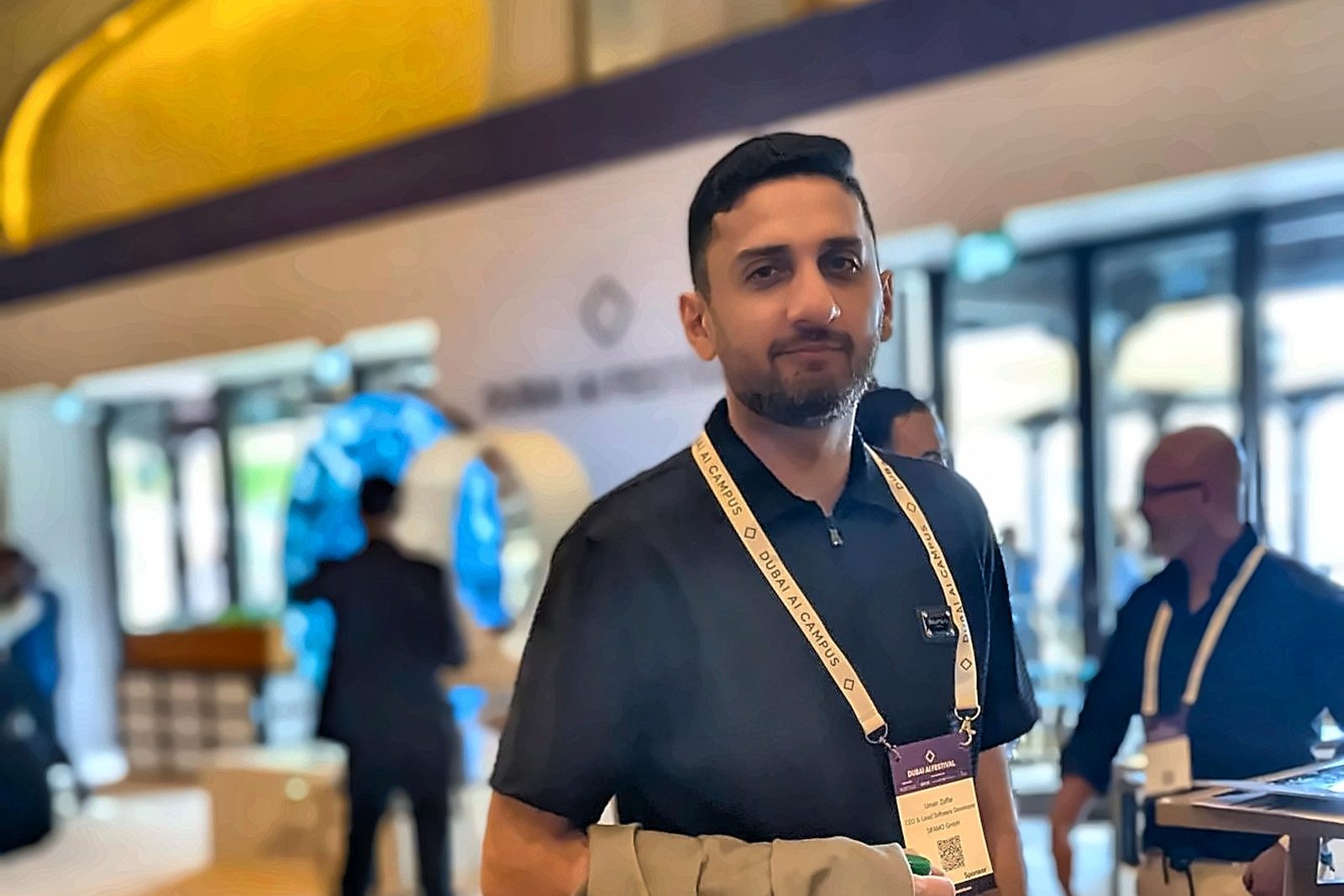
You probably typed AI Governance Consultant Dubai into a search box to get here. I am a German AI consultant who runs AI systems in regulated industries, hosted his own AI summit in the Burj Khalifa and spends part of his year in Dubai, Abu Dhabi and Doha. This page explains why that combination is useful for a company in the UAE or the wider Gulf, what the rules look like as of November 2026.
The Gulf has speed and capital. Europe has the rules and the operating experience: years of running software that decides about people under supervisors who ask questions. Companies in the UAE that serve EU customers need both, usually discovered when a European bank sends a due diligence questionnaire with a section on the EU AI Act. I build the control layer that lets you run AI in production and prove it to a regulator, an auditor or an EU counterparty.
AI Governance Consultant Dubai: why a German for the Gulf
The honest answer first: a consultant from Germany is not the obvious choice for a company in Dubai. The region has lawyers, technology partners and fast government bodies. What it has less of is people who have run AI in regulated production for years and sat through the audits that follow.
Germany is a hard school for this. Banks answer to BaFin and the ECB, everyone to the GDPR, since January 2025 the whole financial sector to DORA, and the EU AI Act sits on top. Nothing goes into production there without an owner, a scope, a log and a way to switch it off. In the Gulf that experience becomes an advantage: you can adopt the control without waiting for the regulation.
There is a second reason. A company in the UAE that places AI systems on the EU market, or whose output is used in the Union, falls under the EU AI Act regardless of where it is registered; the three ways are on my page on the EU AI Act for UAE and GCC companies. One person who knows both rulebooks saves months.
My track record in the Gulf
- SIFAMO AI Summit 2025. On 18 February 2025 we hosted our own AI summit in the Armani Ballroom of the Burj Khalifa in Dubai, with a team of 15 from Germany. I gave the session on Cognitive Transformation. Gulf News covered it: Gulf News x SIFAMO AI Summit.
- June and July 2026. About two weeks in Dubai, Doha and Abu Dhabi with our CTO and co-founder Ayman Kalaie: twelve meetings with AI decision makers and investors, investments evaluated, AI partnerships initiated. Why we flew when many advised against it: Invest in Dubai now?.
- SIFAMO AI Summit 2027 in Doha. First talks with Visit Qatar about a second summit with a planned investment of more than one million euros. The concept: European AI governance meets the Gulf’s innovation power and capital. Planning stage, not confirmed.
SIFAMO has no registered office in the UAE. Work for Gulf clients runs remotely from Germany with on-site phases.
The regulatory field guide: UAE, DIFC, ADGM, Saudi Arabia and Qatar
This is my reading as an engineer, as of November 2026 and to my knowledge. It is not legal advice; verify every point with counsel in the jurisdiction concerned. As of November 2026, none of the GCC states had a general AI law in force, so the practical duties come from data protection law, sector regulators and free-zone rules.
UAE federal level
As of November 2026 there is no dedicated federal AI law in force. AI systems are reached by Federal Decree-Law No. 45 of 2021, the Personal Data Protection Law, and by the cybercrime law. Direction: the UAE National AI Strategy 2031 and the 2024 UAE Charter for the Development and Use of AI. A Regulatory Intelligence Office has existed since April 2025, and in June 2026 the Cabinet approved a federal Artificial Intelligence and Data Authority: announced, details pending. For banks: the Central Bank of the UAE issued AI guidance for licensed financial institutions in February 2026.
DIFC
The Dubai International Financial Centre is the most specific jurisdiction in the region for AI, as of November 2026. Data Protection Law No. 5 of 2020 is complemented by Regulation 10 on autonomous and semi-autonomous systems, in force since 1 September 2023. It introduces the roles of Deployer and Operator, treats the Deployer much like a controller, places enhanced duties and restrictions on high-risk systems and follows a certification-based approach, with further Commissioner guidance expected in 2026.
ADGM
Abu Dhabi Global Market works under its Data Protection Regulations 2021. As of November 2026 there is no equivalent of DIFC Regulation 10, so the data protection principles carry the weight: purpose limitation, data minimisation, security and the rights of data subjects where decisions are automated.
Saudi Arabia
In the Kingdom, SDAIA is the authority that matters. The Personal Data Protection Law has been in force since September 2023, with fines of up to SAR 5 million. SDAIA has published generative AI guidelines for government and for the public, both non-binding as of November 2026, and an AI Adoption Framework. A draft Responsible AI Policy went out for consultation in April 2026; as of November 2026 its status was open.
Qatar
Qatar has the Personal Data Privacy Protection Law No. 13 of 2016, principles for ethical AI from the Ministry of Communications and Information Technology from 2025 and, for the financial sector, the Qatar Central Bank AI Guidelines, binding for QCB-licensed firms as of November 2026. Qatar National Vision 2030 sets the direction.
What a governance layer does and why it is jurisdiction-neutral
Every rulebook above asks the same four questions: Who is accountable for this system? What may it see and do? How did its decision come about? Who can stop it? The EU AI Act asks them as risk management, logging and oversight; DIFC Regulation 10 as Deployer and Operator; the central banks as model risk. The answers are one piece of infrastructure, built at SIFAMO since 2024.
- System registry. One record per model or agent in production: owner, purpose, risk class, scope, version, evaluation results, expiry date. No registration, no route to a model.
- Policy gateway. The only door to any model. It checks permissions and data zones, pseudonymises personal data so that IDs go to the model and names never do, applies tool allow-lists and budgets to agents, and decides between return, abstain and escalate.
- Evidence log. Append-only, written by the gateway: input reference, model and prompt version, sources, policy version, output, signals, reviewer action. The test: can an auditor reconstruct a decision months later?
- Tiered human oversight. Full review for high-impact decisions about people, sampled review with blind re-checks for medium impact, monitoring only for the rest.
- Kill switch and quality gates. A registry flag the business owner can set without a deployment, and gates before every go-live on a test set the business owns.
- Data rules. Pseudonymisation with IDs and data zones in red, gray and green; retrieval with access rights enforced at query time; least privilege for agents, with their own credentials and a sandbox defined by network policy rather than by a prompt.
None of this mentions a jurisdiction. A registry entry in Dubai looks like one in Frankfurt; what changes is the mapping of record fields to articles and guidelines. The mapping is a document, the controls are infrastructure. Build it once, and every new rulebook, from a future UAE federal AI law to the next DIFC guidance, is a mapping exercise instead of a rebuild. The full architecture is in my post on the governance layer; see also AI Governance.
AI Governance Consultant Dubai: services for UAE and GCC clients
- Governance assessment. A few weeks. We take stock of every AI system in use, classify each against the rulebooks that apply to you and map the gaps against the governance layer. Result: inventory, classification, gap list, plan.
- Governance layer build. Registry, policy gateway, evidence log, oversight tiers and kill switch at the scale your first use cases need, and the first production system taken through the gates. My team builds it; your team operates it afterwards.
- EU market access under the AI Act. For companies that place systems on the EU market or whose output is used in the Union: classification, the decision on an authorised representative in the EU, technical documentation, the conformity path and Art. 50 transparency. As of November 2026 the timeline is this: Prohibitions and AI literacy apply since 2 February 2025, GPAI obligations since 2 August 2025, transparency duties under Art. 50 since 2 August 2026. The Digital Omnibus on AI (Regulation (EU) 2026/1744) moved the high-risk obligations: Annex III systems from 2 December 2027, Annex I products from 2 August 2028. Details on the EU AI Act for UAE and GCC companies page; banks and insurers also see DORA and the EU AI Act together.
- Executive briefings and keynotes. Half a day with a board on what AI governance means for your organisation, or a keynote on Cognitive Transformation at your conference. Formats on my AI keynote speaker page.
How an engagement runs between Frankfurt and Dubai
My base is Frankfurt and Berlin. The Gulf is one to three hours ahead of Germany depending on country and season, so a working day overlaps almost fully. The rhythm is weekly calls plus on-site phases in Dubai, Abu Dhabi, Doha or Riyadh at kick-off, architecture workshop, go-live and board presentation. English is the working language; German is available where the counterpart is the subsidiary of a German group. I do not publish day rates; you get a figure after the first conversation.
Typical mistakes I see in the Gulf
- Waiting for the law. “There is no AI law yet, so we have time.” The PDPL, the DIFC rules and the central banks are already there.
- Policy without plumbing. A responsible AI policy with principles and a committee, and not one technical control that enforces it.
- Data residency as the only governance topic. Keeping data in the country answers one question. It says nothing about who owns the system, what it may do and who can stop it.
About Umair Zaffar
I am the founder and CEO of sifamo GmbH, an AI consultancy for regulated industries in Berlin and Frankfurt am Main. Founded in 2019, bootstrapped, 28 people in 2026. I come from enterprise architecture and spent more than ten years building large platforms for banks, insurers and the public sector. Our clients include Commerzbank, VW Bank, Bosch, DHL, Belron, Zurich, VGH and the German federal administration. I coined the term Cognitive Transformation for the step after digitalisation. More on my AI expert page and my founder page.
Frequently asked questions
Do you have an office in Dubai?
Not yet. SIFAMO has no registered office in the UAE. I work for Gulf clients remotely from Germany with on-site phases and am in Dubai, Abu Dhabi and Doha several times a year.
Does a company in the UAE have to care about the EU AI Act?
Only if it is in scope. As of November 2026 that happens in three ways: placing an AI system or a general-purpose model on the EU market, output of your system used in the Union, or an EU subsidiary or importer. Otherwise the Act is a useful blueprint and nothing more.
How is this different from what a law firm does?
A law firm reads the law and writes the opinion. I build the system that makes the opinion true in production; the two work best together. Inside Europe the same service runs under EU AI Act consultant.
Can we start with a briefing or a keynote instead of a project?
Yes, and many clients do. A half-day briefing or a keynote is often a better way in than a proposal, because afterwards your board knows which questions to ask.
If you are looking for an AI Governance Consultant Dubai and the wider Gulf can rely on, reach me via the contact page, by e-mail at contact@sifamo.com or on LinkedIn. Tell me which systems you run and which regulators you answer to, and I will tell you in the first call what I would do first.