

Cognitive Transformation is the step after digitalisation: processes and systems that already run digitally become intelligent with AI. Not as a pilot in a niche, but in the core processes, with strategy, governance and engineering from one source. This page explains what I mean by the term, what the path looks like and where it fails in practice.
Most of the companies I work with have their digitalisation behind them. Applications arrive through portals, files live in document management systems, processes run in workflow engines. And yet at every point where something has to be read, assessed or decided, a person sits there retyping fields, comparing documents and applying rules from memory. Digital does not mean intelligent. The process has become electric, but it does not think.
That gap is exactly what I mean when I talk about Cognitive Transformation. I have used the term for some years in keynotes and in projects, because “digital transformation” and “AI strategy” both miss the point. The first is finished, the second remains a slide deck in many organisations.
What Cognitive Transformation means
Cognitive Transformation means that a company rebuilds its already digital processes, data and systems so that software can read, understand, assess and, within clearly defined boundaries, decide. The transformation is not about a tool but about the way work flows through the company: which steps a machine prepares, which a human checks, which a machine completes and who is accountable at the end.
Three things are non-negotiable for me, otherwise it is not a transformation but an experiment: a strategy that says which processes become intelligent first and why; a governance that defines what the systems may do and how they are controlled; and engineering that integrates the systems into the existing landscape. These three from one source is the core of what we offer at SIFAMO.
How it differs from digital transformation
Digital transformation replaced paper with data and removed media breaks. Its result is a process that works without a printout but follows the same logic as before. The case handler sees the same fields, just on a screen. Cognitive Transformation starts exactly there: it takes the data that digitalisation created and builds systems from it that understand the content. Without digitalisation this is impossible. If you still receive faxes, you do not need a language model, you need a scanner and a database first.
How it differs from AI pilots
A pilot proves that a model can do a task in principle. In 2026 that is no longer an insight. The open question is a different one: can the company build this capability into a core process, with access to real data, with owners, with a log and with a way to switch it off again? Pilots do not answer that question, they sidestep it. That is why I have seen twenty pilots at many clients and not a single system in production.
The three layers: process, data, decision
When we examine a company on its path to Cognitive Transformation, we look at three layers. On each of them, today’s AI building blocks have a different place.
- Process layer: this is about the flow of work: intake, routing, handling, approval. Large language models take over reading and structuring unstructured input, such as e-mails, claims notifications or applications with attachments. Agents chain together steps that a human used to carry between systems. The fastest benefit lies on this layer, because nothing is decided, only prepared.
- Data layer: without clean, accessible and legally usable data, every model stays blind. Retrieval Augmented Generation, RAG for short, is the building block that gives models access to the company’s knowledge: policies, contracts, case histories, product documentation. What matters is that access rights are enforced at retrieval time, not only at ingestion, and that personal data is pseudonymised before a model sees it. We work with IDs instead of names and with data zones in red, gray and green that define what a model may reach at all.
- Decision layer: here preparation becomes a determination: claim accepted, loan declined, candidate invited. On this layer models are assistants, not decision makers, at least wherever people are concerned. The model delivers an assessment, a rationale and sources; a human or a rules engine decides, and every step is logged. Agents work here only with minimal rights: their own credentials, a list of allowed tools and a budget of steps.
Most companies start on the process layer, underestimate the data layer and talk about the decision layer too early. But the order is not arbitrary: skip the data layer and you get a model that sounds convincing and is wrong.
Why regulated industries need control before model
Banks, insurers and public authorities have one particularity: almost every decision they make affects people and must be explainable to a supervisor. BaFin, DORA, MaRisk and the EU AI Act do not ask how good the model is. They ask who is accountable for it, what it may see, how its decision came about and who can stop it.
That is why we never start a project with the model. We start with four questions: Who owns this system? What is it allowed to see and do? How do we know afterwards what it did? Who can stop it, and how fast? The model is chosen last, because models change every few months and the answers to those four questions should not.
Technically, this leads to a governance layer between business applications and models: a registry in which every model and every agent is recorded with purpose, risk class, owner and expiry date; a policy gateway as the only door to a model, which checks permissions, pseudonymises data and limits tools; an evidence log in which every decision can be reconstructed months later; tiered human oversight that fully reviews high-impact decisions and samples the rest; quality gates before every go-live; and a kill switch that the business owner can pull without a deployment. No registration, no route to a model. How this looks in detail is in my post on the governance layer and on the AI Governance page.
Cognitive Transformation in four maturity stages
I describe the path in four stages. They are not phases a company passes through as a whole, but states of individual processes. An insurer can be at stage three in claims intake and at stage one in benefits assessment. That is exactly as intended.
| Stage | What the machine does | What the human does | What changes |
|---|---|---|---|
| Digitalised | Stores, forwards, displays | Reads, assesses, decides, types | The process is electric, the logic unchanged |
| Assisted | Reads, summarises, suggests, pre-fills | Checks every suggestion, decides | Handling time drops, the quality of the data becomes visible |
| Augmented | Handles standard cases up to approval, detects exceptions, pulls data from several systems | Decides exceptions and all cases affecting people, reviews samples | Roles change, the governance layer becomes mandatory |
| Governed autonomy | Completes defined cases on its own within boundaries, escalates on deviation | Sets boundaries, monitors signals, holds the kill switch | Control lies in rules and the log, not in case-by-case review |
From assisted to augmented changes roles. The case handler turns from processor into reviewer, and the company now needs the governance layer, because systems start carrying cases to approval without individual review. Without a registry and a log, this step gets stopped at the first audit.
Governed autonomy deliberately does not say autonomy. The system completes cases on its own, but only within boundaries that live in code, with signals that report deviations, and with a human who can intervene and does. For decisions about people, this stage remains the exception in regulated industries, and rightly so.
Cognitive Transformation at SIFAMO: our own proof
We did not start with clients, we started with ourselves. SIFAMO has rebuilt itself around AI since 2023, along exactly the path I described above.
Our recruiting was the first process. It was digital, applications came in through portals and were structured, but the pre-selection was done by people reading CVs against requirements. Today an AI system assesses hard skills against the profile with around 90 percent precision. The decision on whom we invite and hire is still made by people. The system is registered, every assessment is traceable, and it has never seen a real name, because we work with IDs.
Our ERP was the second. We extended it with an AI board that reads figures from projects, utilisation and finance and explains anomalies before we find them in the monthly close.
What we learned along the way is now in every client project: start with a process that is digital and hurts. Build the control first, then the model. Measure quality on real cases, not on demos. And tell the team honestly what changes about their work. That we have grown to 28 people in Berlin and Frankfurt, self-financed and without loans, has a lot to do with the fact that we use these tools ourselves every day.
Typical failure modes
- Pilotitis. Twenty proofs of concept, none in production. Each proves what has long been proven, and none clarifies data, accountability and control.
- Model first. The choice of model becomes the fundamental question, governance is supposed to come later. What comes later is the audit.
- Data as an afterthought. The model is supposed to answer from documents in which permissions, versions and personal data are all mixed up. The result is a system that is convincingly wrong or discloses data.
- Boundaries in the prompt. “Do not access production” is an instruction, not a boundary. Boundaries belong in the gateway, the network and the permissions.
- Full review as a promise. “A human checks every output” does not survive two weeks at volume. Then things get rubber-stamped. Tiered oversight with samples and blind re-checks is more honest and more effective.
- Transformation without the business. AI is run as an IT project, and the business is presented with a tool at the end. The people whose work changes have to define from day one what a good result looks like.
- No owner. Nobody wants to hold the kill switch, until the first incident. With us, nothing goes live without a name in the registry.
How an engagement with us runs
I work as an AI consultant with a team of consultants, architects and developers who also build the systems. A typical engagement has five steps, and the order is part of the method.
- 1. Assessment. We take stock of the process landscape, the data situation and the existing AI systems, including the ones IT does not know about. Result: an inventory, a classification under the EU AI Act and an honest statement of where each process stands on the maturity path.
- 2. Use-case portfolio. Dozens of ideas become three to five, assessed by benefit, data situation, risk class and integration effort. We also say what we would not build, and why.
- 3. Governance layer. Before the first use case goes live, the registry, policy gateway, evidence log, oversight tiers and kill switch are in place. Not as a mega project, but at the scale the first use cases need, and built so that all further ones take the same route.
- 4. First production system. One process, real data, real users, with quality gates before go-live and measured quality afterwards. Usually at the “assisted” or “augmented” stage. This system is the template for everything that follows.
- 5. Scale. Further use cases run through the same layer, teams in the business and in IT take over operations and further development. Our goal is that the knowledge stays in the company, not with us.
Keynotes on Cognitive Transformation
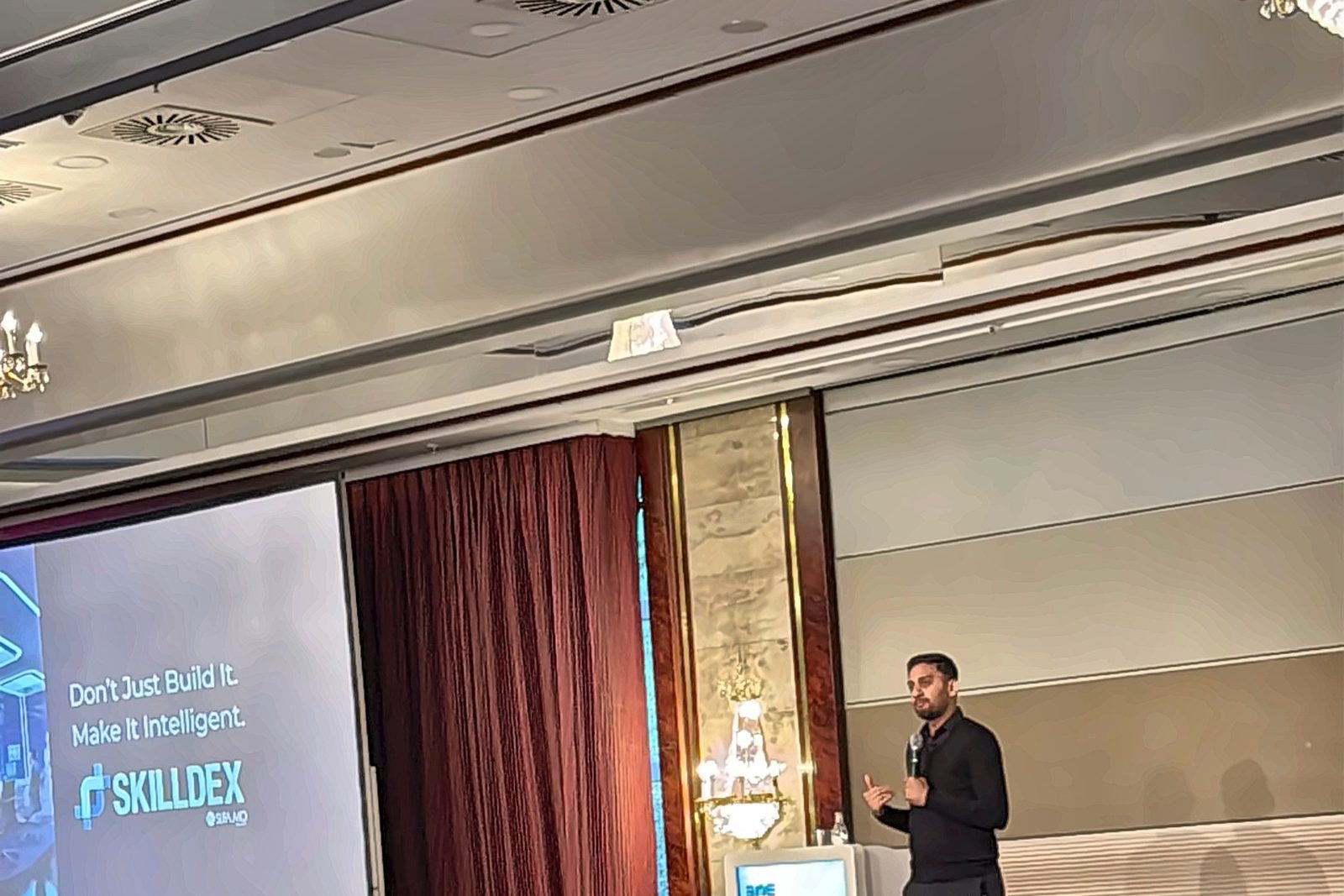
As an AI speaker I give keynotes on exactly this path: from digitalisation to Cognitive Transformation, for boards, business units and conferences in Frankfurt, Berlin and Dubai. Often that is a better way in than a proposal.
About Umair Zaffar
I am the founder and CEO of sifamo GmbH, an AI consultancy for regulated industries with offices in Berlin and Frankfurt am Main. Founded in 2019, self-financed and without loans, 28 people today. I come from enterprise architecture and spent more than ten years building large platforms for banks, insurers and the public sector before we focused on AI in production in 2023. Our clients include Commerzbank, VW Bank, Bosch, DHL, Zurich, VGH and the German federal administration. How I work as an AI expert is on that page; the story of the company is on my founder page.
Frequently asked questions
Is Cognitive Transformation just a new word for AI strategy?
No. An AI strategy is a document. Cognitive Transformation is the rebuilding of processes, data and decisions, with governance and engineering, until systems run in production. The strategy is the first of five steps, not the result.
Do we have to finish digitalisation first?
For the processes that are supposed to become intelligent, yes. A process that runs on paper has no data a model could read from. For the company as a whole, no: it is enough to start with the processes that are already digital and cause the most effort.
How long does it take to reach the first production system?
Assessment and use-case portfolio usually take a few weeks. The governance layer at the scale of the first use cases and the first production system then take a few months, depending on the data situation and integration effort. More important than the duration is that the first system passes through all the gates.
Do we need our own models for this?
In almost all cases, no. The work is in data, integration and control, not in the model. The governance layer is provider-agnostic by design: switching models is a change in the registry plus a run through the quality gates, not a rebuild.
Want to know where your processes stand on the path to Cognitive Transformation and which step makes sense next? Reach me via the contact page, by e-mail at contact@sifamo.com or directly on LinkedIn. If you want to clarify the regulatory side first, my guide to the EU AI Act is the place to start.